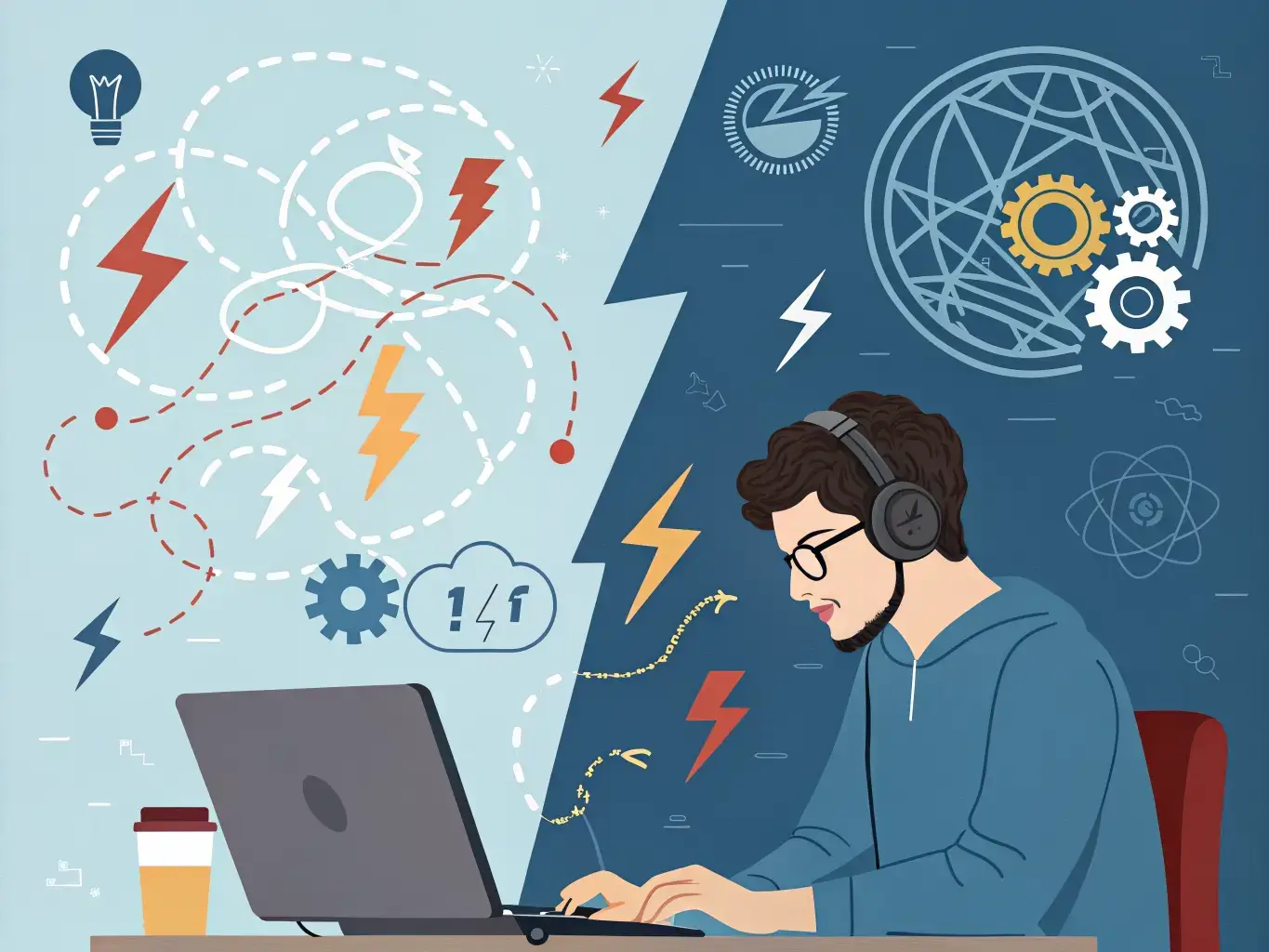
One of my high school teachers used to say: “Only good students should be allowed to use guide books to seek Math Solutions. Because, a good student might learn new math solving techniques from the guide book but a weak student might blindly copy the math solution without learning anything”. So I think, With AI, good experienced developers will learn new skills and new problem solving techniques, but a lot of new developers might end up copy-pasting AI generated codes without learning anything or improving their coding skills.
Coding with AI speed-boosts development while simultaneously reshaping how software engineers think and solve problems. Examining both sides of this dynamic reveals why developers view AI as a dual-edged tool.
Here are few positive and negative sides of AI assisted coding:
The Blessing: Speed, Flow, and Accessibility
- Eliminating Syntax Friction: AI handles routine boilerplate, framework setup, and repetitive patterns instantly, keeping developers in a state of flow rather than context-switching to look up basic syntax.
- Accelerated Learning Curves: Developers can explore unfamiliar programming languages, libraries, or APIs faster. Asking AI to explain a legacy codebase or translate code between languages acts like an on-demand mentor.
- Rapid Prototyping: Turning an concept into a working proof-of-concept takes minutes instead of days, allowing developers to test ideas, iterate on user feedback, and fail fast without massive time investment. I must say, I love AI for giving us the super power of building new stuffs pretty fast.
- Automating Testing and Refactoring: AI excels at generating unit tests, identifying basic edge cases, writing documentation, and suggesting performance optimizations for routine functions.
- Fast debugging: AI can detect bugs, coding level security issues and bad programming practices with high level of accuracy and efficiently, this saves hours of manual coding review line by line.
The Curse: Cognitive Atrophy and Complex Reasoning
- Erosion of Deep Problem-Solving: Relying on AI for immediate answers can skip the critical “struggling phase” of engineering—the process where real mental models, spatial reasoning, and architectural intuition are forged. If we stay in the comfort zone of AI, our problem-solving skills might deteriorate over time.
- The “Illusion of Competence”: Accepting AI-generated code without full comprehension creates a false sense of mastery. When a critical bug occurs or systems fail at scale, developers may lack the fundamental understanding required to debug the root cause.
- Architectural and Nuance Blindness: AI models operate on pattern matching from past data. They struggle with high-level architectural trade-offs, system-wide design patterns, complex edge cases, and business-specific constraints that require human judgment.
- Security and Quality Creep: Blindly accepting suggested code introduces subtle bugs, hallucinated packages, outdated security practices, and maintenance debts that compound over time.
I am not saying AI is bad, but I am concerned that in near future we might have to deal with “AI-savvy” unskilled people, those people would be good at using AI but bad at programming problem solving skills!